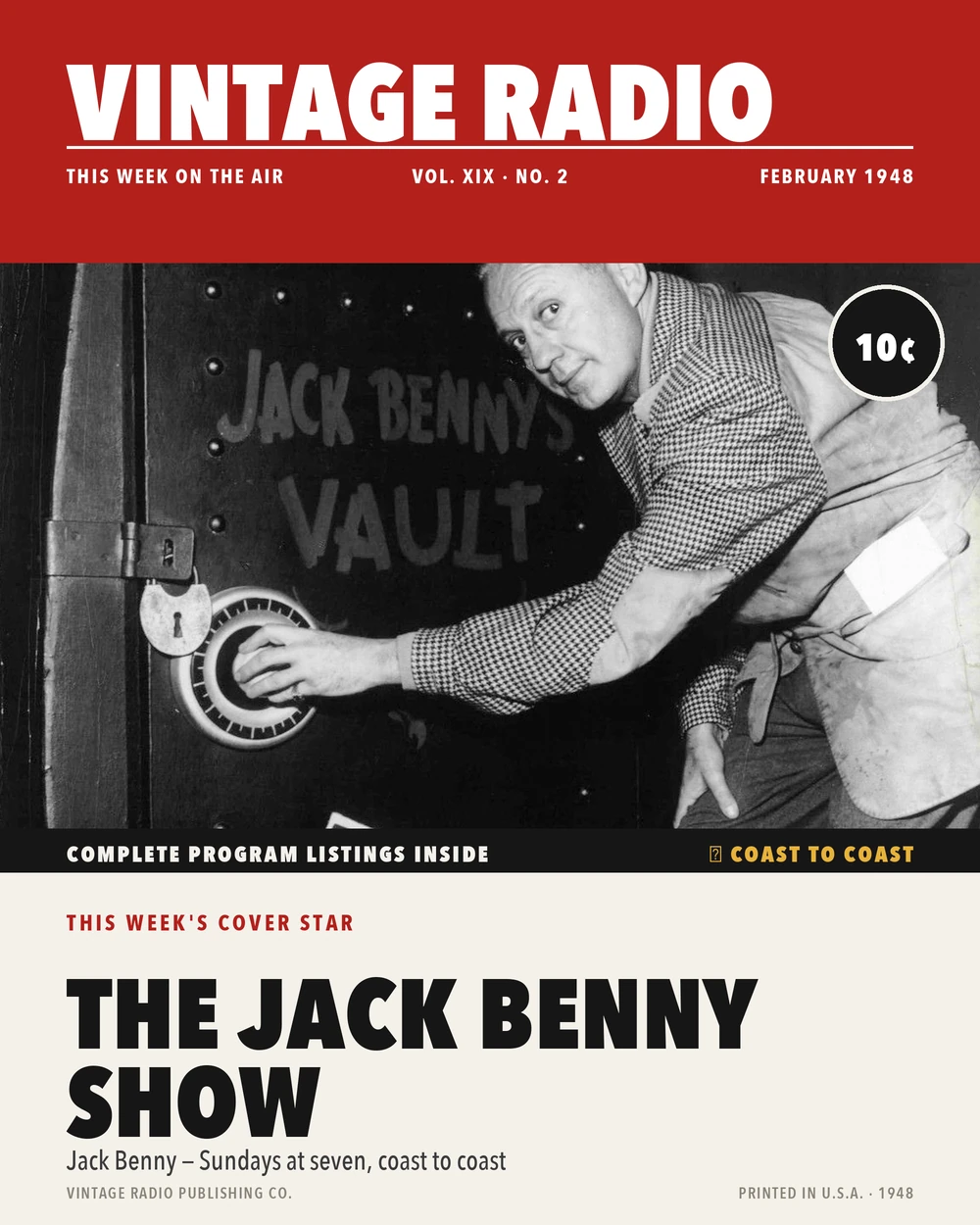
The Jack Benny Show
The Character That Ran a Show
The single most distinctive thing about The Jack Benny Show — the thing that separated it from every other comedy on American radio — was that Jack Benny built the entire enterprise around a fictional version of himself. He wasn't playing a detective or a bumbling husband or a wiseacre from the Bronx. He played Jack Benny, and that Jack Benny was vain about his blue eyes, claimed perpetually to be 39 years old, played the violin badly, and held onto money with a grip so tight that the mere act of reaching for his pocketbook became a national joke. Fred Allen, Benny's long-running comedic rival, once claimed to be "the greatest living authority on Jack Benny" because, as Allen explained, "I have seen him reach for his pocketbook. No other living American can make that statement."
What made the character work was that none of it was true. Benny overtipped in restaurants, gave away his time in countless benefit performances, and was by all accounts lavish with praise for the people around him. The miser, the coward, the egotist with the tin ear — that was the construction, built over years of careful writing and performance. A 1947 Newsweek profile noted that Benny hand-picked his writers and cast, directed rehearsals down to the last fine reading of a line, and then refused to publicly take credit for any of it. The humility was as genuine as the stage persona was invented.
The show ran from May 2, 1932, through June 22, 1958, on a rotating series of networks and sponsors. At its peak, Benny's audience reached 30 million people each week. That number belongs to a medium without television, without streaming, without fragmentation — but even so, it is a remarkable figure for a comedy program built not on spectacle but on the comic deflation of one man.
How It Got Started
Benjamin Kubelsky was born on February 14, 1894, in Chicago, the son of Meyer Kubelsky, who had come to the United States from Lithuania in 1889 and settled in Waukegan, Illinois, where he ran a saloon. Benny's father gave him a violin when he was 6 years old. By 8 he was a prodigy, making frequent trips to Chicago to study under Hugo Kortschak at the Chicago Musical College. In 1911 he was playing local vaudeville theaters for $7.50 a week — and in one of the great near-misses of American comedy, he found himself sharing a bill with the young Marx Brothers. Their mother Minnie invited him to join the act. His parents refused.
He eventually formed a vaudeville act with Cora Salisbury, who played piano at the Barrison Theater in Waukegan — billed as "Salisbury and Kubelsky: From Grand Opera to Ragtime," touring Illinois and Wisconsin. When Salisbury retired, Benny continued with pianist Lyman Woods. He spent six years in vaudeville playing the violin without speaking a single joke.
The jokes came during World War I. Benny enlisted in the Navy and performed in a maritime revue at the Great Lakes Naval Station, where he found his voice, quite literally, in front of a live audience. The name took longer to settle. Violinist Jan Kubelik threatened legal action over Benjamin Kubelsky, so he became Ben K. Benny. Then bandleader-comedian Ben Bernie objected to that one too. By 1921 he had landed on Jack Benny, and it stuck.
By 1929, Benny had signed a five-year contract with MGM after agent Sam Lyons convinced Irving Thalberg to watch him perform at the Orpheum Theatre in Los Angeles. His first film role came that same year in The Hollywood Revue of 1929, and between 1930 and 1945 he appeared in at least 18 pictures — among them Charley's Aunt (1941), Ernst Lubitsch's To Be or Not to Be (1942), regarded as his finest film performance, and The Horn Blows at Midnight (1945), which he turned into a perpetual self-deprecating joke on the radio program. The 1940 feature Buck Benny Rides Again lifted the cast's western-spoof radio skits onto the screen.
By 1932, Benny was a vaudeville headliner appearing on Broadway in Earl Carroll's Vanities. Newspaper columnist Ed Sullivan invited him onto a radio interview program as a favor, and Benny's debut on Sullivan's quarter-hour show on March 19, 1932, caught the attention of Canada Dry Ginger Ale. Canada Dry signed him, and his first radio show went out on the Blue Network on May 2, 1932, with announcer George Hicks, maestro George Olsen, and singer-comedienne Ethel Shutta. The show aired 30 minutes on Mondays and Wednesdays at 9:30.
Benny's wife, Sadye Marks — he had married her on January 14, 1927, when she was a teenage clerk at the hosiery counter of the Los Angeles May Company — joined the cast on August 3, 1932, as Mary Livingstone. The character had been invented on the fly: Benny and writer Harry Conn needed to fill short timing during a rehearsal, and they created a young Benny fan from Plainfield, New Jersey. Sadye Marks suffered severe microphone fright that never entirely left her, but Mary Livingstone became one of the most recognizable voices in American radio.
The Cast That Made It Work
Every character in Benny's ensemble was designed to take something from him, and Benny's comic genius was in losing gracefully. Don Wilson joined as announcer on April 6, 1934, and stayed with Benny through the end of the television show in 1965 — more than three decades. Wilson stood a little over six feet tall and weighed in the mid-220s, though Benny exaggerated his size with an unending supply of fat jokes that Wilson absorbed with professional good humor.
Phil Harris came aboard on October 4, 1936, as the wisecracking bandleader-figure, providing a different kind of opposition. Harris was cool where Benny was flustered, self-assured where Benny was vain, and the dynamic gave the show a sharp new edge. Mahlon Merrick arranged the music and conducted throughout the later years, while Harris worked as the front man and comic foil.
Eddie Anderson first appeared on March 28, 1937, as a Pullman porter — a one-off role that audiences responded to strongly. By June 20, 1937, he had become Rochester Van Jones, Benny's valet, and Rochester quickly established himself as the only person in the ensemble who could reliably win an argument with his employer. A 1947 Saturday Evening Post piece by Cleveland Amory noted that Anderson had "never been anybody's valet," maintained a block-large estate with three servants of his own, drove an expensive car, and earned approximately $700 per air-time minute.
Dennis Day arrived on October 8, 1939, replacing singer Kenny Baker, who had defected to The Fred Allen Show the previous June. Day's real name was Eugene Patrick McNulty. Mary Livingstone had spotted his photograph in a file at Benny's agents' office and heard a transcription of his voice; she pushed for an audition. At the audition, when Benny called McNulty over the intercom, the young tenor's nervous reply was "Yes, please" — which, according to Mary, clinched it. McNulty was given a tentative contract with two weeks to make his mark. Writer Milt Josefsberg later recalled that nobody initially realized Dennis Day had uncanny timing for feed and punch lines, or that he was one of the best mimics in radio. His character settled in as a sweet Irish kid with a head full of air, and he stayed for the rest of the run.
Mel Blanc joined on February 19, 1939, after auditioning voices he was using in Warner Brothers cartoons. When Benny asked if he could do a polar bear, Blanc let out a roar and Benny, by the account preserved in the record, "went into convulsions" and put him in the show. Over the years Blanc played Carmichael the polar bear (who, according to Rochester, ate the gas man in 1941), Benny's sputtering antique Maxwell automobile — the Maxwell had last been produced in 1925, making it genuinely archaic by the time it appeared — Professor LeBlanc the violin teacher, a parrot named Polly, Sy the little Mexican, and the train station announcer whose leisurely call of stops for "Anaheim, Azusa and Cue...amonga" became one of the show's signature running gags, with the pause between "Cue" and "amonga" growing longer over the years.
Frank Nelson, who first appeared on June 1, 1934, played a rotating series of nameless sarcastic characters. Nelson later recalled that his whole purpose on the show was "to annoy the hell out of Jack Benny." Joseph Kearns played Ed, the vault guard who had been on duty since the Revolutionary War. Artie Auerbach joined in 1946 as Mr. Kitzel the hot dog man, who popularized the phrase "peekle in the meedle with the mustard on top." Sheldon Leonard played the racetrack tout at the train station. Ronald and Benita Colman appeared as special guests several times a year, providing an air of refined Hollywood glamour that Benny perpetually failed to match. The Colmans made their first appearance on December 9, 1945.
The Writing Room
The show's writers deserve as much credit as anyone for what it became. Harry Conn was the original writer and stayed through early 1936, when he made contract demands that Benny found unreasonable. They parted badly, and Conn later sued Benny for $65,000; the suit was settled out of court. A transitional period followed with Al Boasberg, Howard Snyder, and Hugh Wedlock Jr., then Bill Morrow and Ed Beloin took over.
In 1943, Morrow and Beloin were replaced by a four-person team — Sam Perrin, Milt Josefsberg, George Balzer, and John Tackaberry — who would shape the show through its best years. The production process they developed was deliberate and meticulous. After each Sunday broadcast, the writers would meet in Benny's dressing room to agree on the theme for the following week's script. The show was divided into two segments — opening cast banter and a dramatic spoof — and the writing teams alternated between the two each week. On Thursdays, Benny would review and edit the rough script. He went into spasms of laughter at the writers' lines, which was taken as a good sign by everyone in the room. Producer Hilliard Marks — who was Mary Livingstone's brother — would then line up supporting talent after Benny's review. A cast reading followed on Saturday, and on Sunday Benny preferred only a loose run-through to avoid overrehearsing; the show went out live in the East at 7 p.m.
George Balzer later attributed the show's growth spurt in the 1940s to the pressure of World War II, which caused old vaudeville conventions to fall away and forced the writing to become sharper. The show never fully returned to its music-heavy origins after the Jell-O years; by the Lucky Strike era it was a tight comedy machine. The Jell-O years also produced one of the strangest sponsorship problems in radio history: Benny's trademark opening, "Jell-O again" — a pun on "hello again" — drove demand for the product so high that when wartime sugar rationing took hold, General Foods literally could not manufacture enough Jell-O to keep up. The company pulled its flagship from the show and switched Benny to Grape-Nuts from 1942 to 1944.
Running Gags and Live Disasters
No account of the Benny show is complete without its running gags, and no account of the running gags is complete without the moments when the show nearly collapsed on live air. The vault, the Maxwell, the violin, the age, the fat jokes at Don Wilson's expense — these were the show's fixed architecture, and the writers built everything else on top of them.
The vault gag debuted on January 7, 1945, the same broadcast on which Mel Blanc first played the train station announcer. The premise — that Benny had a fortified underground vault protected by a guard who had been there since the Revolutionary War — was an extension of the miser character that could be revisited indefinitely. It was.
The live disasters were their own category of comedy. Mary Livingstone's on-air fluffs became legendary inside the industry and among the audience. On October 27, 1946, she asked for "a chiss swease sandwich." On December 3, 1950, she told Benny to "run my car up on the grass reek." Both were authentic stumbles, not written in.
The most celebrated near-collapse on the show was the "Drear Pooson" incident of January 8, 1950. Don Wilson flubbed Drew Pearson's name on live air. The writers secretly rewrote Frank Nelson's upcoming lines to include the mistake without telling Benny, so that when Benny heard it again, the confusion was genuine. Benny collapsed laughing on live air. Frank Nelson later recalled that Benny's reaction surpassed even his response to the famous "your money or your life" pause — one of the most celebrated moments in the show's history, in which Benny's silence after a robber's ultimatum stretched long enough to produce one of radio's most famous laughs.
In late 1945, the writers devised an "I Can't Stand Jack Benny Because" contest, offering $10,000 in Victory Bonds and a $2,500 grand prize. More than 300,000 letters flooded NBC. The judges included Goodman Ace, Peter Lorre, and Fred Allen. The winning entry was read by Ronald Colman on February 3, 1946.
The Feud and the Move to CBS
The long-running comedic feud with Fred Allen began on April 5, 1936, when Benny ran a skit called "Clown Hall Tonight," satirizing Allen's Town Hall Tonight. The real escalation came on December 30, 1936, when Allen, on his CBS broadcast, said that 10-year-old violin prodigy Stuart Canin was already a better player than "a certain alleged violin player." Benny rose to the bait, and the exchange swelled into a fixture of American radio comedy that ran for fifteen years, filling the press with insults meticulously constructed to sound spontaneous. Allen once remarked that Benny couldn't "ad-lib a belch at a Hungarian dinner." The two sides even pushed toward a staged boxing match, which sold out — but was never actually held.
The feud also had a quiet coda that almost nobody knew about at the time. Years after Benny's death, his estate and Allen's together established a scholarship fund for Stuart Canin, the small boy Allen had used as a needle. Canin became the first American to win the Paganini violin competition and served as concertmaster for the San Francisco Symphony.
In 1949, CBS president William S. Paley won Benny away from NBC by exploiting a tax arrangement that allowed Benny to incorporate himself as a business, sell his show to the network, and pay only 25 percent under capital gains regulations instead of 77 percent on personal earnings over $70,000. NBC executives David Sarnoff and Niles Trammel hesitated over the legality of the arrangement; Paley proceeded. The CBS talent raids also captured Amos 'n' Andy, Bing Crosby, and Red Skelton. Benny moved to CBS beginning January 2, 1949, continuing as The Lucky Strike Program without missing a single week.
Phil Harris departed in 1952; writer Milt Josefsberg described the move as a matter of economics. Bob Crosby replaced him as the token bandleader as of September 14, 1952. In 1954, Mary Livingstone began recording her lines at home — script girl Jeanette Eymann played the Mary role for the studio audience, and the real Mary was dubbed in for the broadcast tape.
The final original run closed on May 22, 1955. From October 28, 1956, through June 22, 1958, CBS aired The Best of Benny, a series of repeat broadcasts sponsored in 1957–58 by the Home Insurance Company.
Television and Legacy
Benny had actually made his television debut a year before the network series began, on local Los Angeles station KTTV in 1949. The Jack Benny Program on television launched October 28, 1950, and ran on CBS through the 1963–64 season; in a small irony, the final 1964–65 season moved to NBC — the network Paley had raided him from a decade and a half earlier. The TV show spent several years in Nielsen's top 20 and earned 17 Emmy nominations with 6 wins, including Benny's personal awards for Best Continuing Performance (Male) in a Comedy Series in 1958 and 1959, and the program's Emmy for Outstanding Program Achievement in the Field of Humor in 1961. It was finally cancelled in 1965, knocked off, as the record notes, by Gomer Pyle.
Benny was preparing to star in the film of Neil Simon's The Sunshine Boys when his health failed in late 1974. His lifelong best friend George Burns took the role and won the Academy Award for it. Benny died of pancreatic cancer on December 26, 1974, at age 80. At the funeral, Burns began the eulogy but broke down crying; Bob Hope rose and said: "For a man who was the undisputed master of comedy timing, you'd have to say that this was the only time when Jack Benny's timing was all wrong. He left us much too soon."
The rest of the cast followed across the next two decades — Eddie Anderson in February 1977, Don Wilson in April 1982, Mary Livingstone in June 1983, Dennis Day in June 1988, and Phil Harris not until August 1995. Per his will, Benny had arranged for a single long-stemmed rose to be delivered to Mary every day for the rest of her life.
The honors came in clusters. Benny had received three stars on the Hollywood Walk of Fame in 1960 — one each for television, motion pictures, and radio. Posthumously he was inducted into the Television Academy Hall of Fame in 1988 and the National Radio Hall of Fame in 1989. The U.S. Postal Service issued a 29-cent Benny stamp in 1991, and when first-class postage rose to 39 cents in 2006, fans petitioned for a new stamp in honor of his perpetual stage age. A statue of Benny with his violin stands in downtown Waukegan, and Jack Benny Middle School there carries the motto "Home of the '39ers." His family donated his papers and a collection of television shows to UCLA, which in 1977 established the Jack Benny Award for Comedy; Johnny Carson was the first recipient. Benny himself had donated a Stradivarius — purchased in 1957 — to the Los Angeles Philharmonic, quipping: "If it isn't a $30,000 Strad, I'm out $120."
In 1990, Warner Books published Sunday Nights at Seven: The Jack Benny Story, drawn from a roughly 400-page unpublished autobiography Benny had written in the late 1960s and his daughter Joan discovered among his papers after his death. George Burns wrote the foreword. In 2017, Professor Kathryn H. Fuller-Seeley published Jack Benny and the Golden Age of American Radio Comedy with University of California Press — the first full-length scholarly account of the broadcasting career, and the recipient that year of the Theatre Library Association's Richard Wall Memorial Award Special Jury Prize.
More than 600 Benny shows survive on tape. The broadcast archive was meticulously logged by Gary Dunn and John and Larry Gassman, whose work helped establish the specific dates that anchor the show's long chronology. What they documented is one of the most sustained comedy enterprises in American broadcasting — twenty-six years of a man pretending, very convincingly, to be worse than he was, and a template that the situation comedy has been working from ever since.